

A whale shark glides peacefully alongside a diver in tropical waters, showcasing its massive yet gentle nature.
Table of Contents
- Quick Facts: Whale Shark at a Glance
- What Is a Whale Shark?
- Why Is It Called a "Gentle Giant"?
- Whale Shark Size
- The 3,000 Teeth That Don't Bite
- Whale Shark Diet
- Whale Shark Habitat
- The Starry Skin: Nature's Fingerprint
- Whale Shark vs Great White Shark
- How Scientists Study Whale Sharks
- Conservation: Why Are They Endangered?
- Swimming with Whale Sharks
- Fun Facts About Whale Sharks
- Interesting Numbers
- Myths vs Facts
- Frequently Asked Questions
- Conclusion
Quick Facts: Whale Shark at a Glance
| Feature | Details |
|---|---|
| Scientific Name | Rhincodon typus (pronounced: RIN-co-don TIE-pus) |
| Average Length | 18-33 feet (5.5-10 m) |
| Max Recorded Size | 61.7 feet (18.8 m) - longer than a school bus! |
| Weight | Up to 20.6 metric tons (about 4 elephants) |
| Lifespan | 70-130 years (recent studies suggest over a century) |
| Diet | Plankton, krill, fish eggs, small fish |
| Feeding Type | Filter feeder (one of only 3 shark species) |
| Teeth | 3,000+ tiny teeth - but does not use them to bite! |
| Status | Endangered (IUCN Red List) |
| Habitat | Tropical and warm-temperate oceans worldwide |
These whale shark facts give you a snapshot of why this animal fascinates marine biologists and tourists alike. But there is much more to discover about the largest fish in the world.
What Is a Whale Shark? Understanding the World's Largest Fish
The first time most people see a whale shark, they expect a dangerous predator. Instead, they meet one of the calmest animals in the ocean.
The whale shark (Rhincodon typus) is not a whale - it is a fish. In fact, it is the largest fish in the ocean and the largest fish in the world. This gentle giant belongs to the shark family, specifically the group called carpet sharks, which also includes nurse sharks and wobbegongs.
Did You Know? The whale shark is one of only three shark species that are filter feeders. The other two are the basking shark and the megamouth shark.
While researching this guide, I compared information from NOAA, IUCN, National Geographic, and recent marine biology studies to ensure every fact is accurate and up to date.
Despite being called a "whale shark," this animal has nothing in common with whales except its massive size. Unlike whales, which are mammals that breathe air and give live birth to fully developed calves, the whale shark is a true fish with gills, scales, and the ability to lay eggs (though scientists believe they may also give birth to live young in some cases).
Taxonomy: Where Does the Whale Shark Fit?
| Rank | Classification |
|---|---|
| Kingdom | Animalia |
| Phylum | Chordata |
| Class | Chondrichthyes (cartilaginous fish) |
| Order | Orectolobiformes (carpet sharks) |
| Family | Rhincodontidae |
| Genus | Rhincodon |
| Species | R. typus |
This classification places the whale shark among the most ancient lineages of fish, with ancestors dating back over 200 million years.
Why Is It Called a "Gentle Giant"?
The nickname is not just poetic - it is earned through decades of observation.
Unlike its distant cousin the Mediterranean Great White Shark, which actively hunts seals and large fish, the whale shark spends its days slowly cruising through the water with its massive mouth open, filtering microscopic plankton like a living vacuum cleaner.
The Behavior That Proves It
- Swimming with humans: In places like Mexico's Isla Holbox, the Philippines' Donsol Bay, and Australia's Ningaloo Reef, whale sharks regularly swim alongside snorkelers and divers without showing aggression. Local guides report that the sharks often seem curious, sometimes approaching boats to "check out" the visitors.
- No recorded unprovoked attacks: According to marine safety records, there has never been a confirmed case of a whale shark attacking a human. Compare that to the great white shark, which, while also not "man-eating," is responsible for more recorded incidents due to its predatory nature.
- Slow and predictable movements: Whale sharks swim at a leisurely 3 mph (5 km/h) - about the speed of a walking human. Their calm, rhythmic movements make them one of the safest large marine animals to observe up close.
Whale Shark Size: How Big Is the Largest Fish in the World?
When people hear "largest fish in the world," they often picture something massive. But whale sharks exceed even those expectations.
Size Comparison
| Comparison | Whale Shark | Great White Shark | School Bus |
|---|---|---|---|
| Average Length | 18-33 ft | 12-15 ft | 35-40 ft |
| Max Recorded | 61.7 ft | 20 ft | - |
| Weight | Up to 20 tons | Up to 2 tons | - |
| Mouth Width | 5 ft (1.5 m) | 2 ft | - |
As you can see, even the average whale shark dwarfs the great white shark - and the largest recorded individuals approach the length of a school bus. This size difference is one reason why the whale shark sits alone at the top of the "largest fish" category.
The "Baby" Paradox

A juvenile whale shark - only about 3-4 feet long - swims in shallow waters. These babies are rarely seen in the wild.
Here is what makes whale sharks even more fascinating: they start tiny. According to research published in marine biology journals, newborn whale sharks are only 21-25 inches (55-64 cm) long - about the size of a large house cat. Scientists rarely see babies in the wild, suggesting they spend their early years in deep, remote waters away from predators.
It takes approximately 30 years for a whale shark to reach sexual maturity. Think about that: a whale shark born in 1996 would just now be ready to reproduce in 2026.
Did You Know? According to the Natural History Museum in London, the largest whale shark ever recorded was 61.7 feet (18.8 meters) long - that is longer than a standard school bus and about the same length as a bowling lane!
The 3,000 Teeth That Don't Bite
Here is a fact that surprises everyone: whale sharks have over 3,000 tiny teeth arranged in more than 300 rows inside their mouths. But here is the catch - they do not use them for chewing.

A whale shark swims with its massive mouth open, filtering plankton from the water. This 5-foot-wide mouth can process 6,000 liters of water per hour.
So Why Do They Have Teeth?
Scientists believe these teeth are evolutionary remnants from their ancient ancestors. Millions of years ago, whale sharks may have had a more varied diet. Today, those teeth are about as useful as your appendix - present, but not functional for feeding.
How They Actually Eat
The whale shark's real feeding tool is its gill rakers - bristle-like structures that act as a sieve. Here is the process:
- Open wide: The shark swims with its mouth agape, creating a current that draws in water and food
- Filter: Water passes through the gills, but plankton and small organisms get trapped on the rakers
- Swallow: The shark periodically closes its mouth and swallows the accumulated food
- Cough and repeat: Sometimes they "cough" to clear debris from their gill rakers before starting again
According to NOAA Fisheries, a single whale shark can filter 6,000 liters of water per hour - enough to fill a small swimming pool.
Whale Shark Diet: What Does a Filter-Feeding Shark Eat?
The answer is surprisingly small: plankton.
The Menu
| Food Type | Description | How They Eat It |
|---|---|---|
| Zooplankton | Tiny drifting animals | Filter feeding while swimming |
| Phytoplankton | Microscopic plants | Same as above |
| Fish eggs | Especially tuna and snapper spawn | Mass feeding events |
| Krill | Small shrimp-like crustaceans | Dense swarms in cold upwellings |
| Small fish | Occasionally | "Ram feeding" - swimming through schools |
This diet explains why whale sharks pose no threat to humans - they simply are not interested in large prey. Their entire digestive system is designed for microscopic food, not seals or fish like their predatory shark cousins.
The Vertical Feeding Technique
Whale sharks have a unique behavior called "vertical feeding" or "standing":
- The shark swims to a dense patch of plankton
- It tilts its body to a near-vertical position (head up, tail down)
- It opens and closes its mouth rhythmically, pumping water through its gills
- This position allows it to "hover" in one spot, maximizing food intake
This behavior, first documented in detail in the early 2000s, is rarely seen in other filter-feeding sharks like the basking shark.
Whale Shark Habitat: Where Do They Live?
Whale sharks are found in tropical and warm-temperate waters across the globe. Unlike many marine species that stick to specific regions, whale sharks are true ocean wanderers.
Top Whale Shark Hotspots
| Location | Best Season | Why It's Special |
|---|---|---|
| Isla Holbox, Mexico | May-September | Massive aggregations feeding on tuna spawn |
| Donsol Bay, Philippines | November-June | First eco-tourism site, community-run |
| Ningaloo Reef, Australia | March-July | Reliable sightings, well-regulated tourism |
| South Ari Atoll, Maldives | Year-round | One of few year-round locations |
| Tofo Beach, Mozambique | October-March | Research hotspot, less crowded |
| Oslob, Philippines | Year-round | Controversial feeding site |
These hotspots attract thousands of tourists every year who want to swim with the largest fish in the world. However, not all locations practice responsible tourism - something we will discuss later in this guide.
Migration Mysteries
Despite decades of research, whale shark migration remains partially unknown. Satellite tagging has revealed some incredible journeys:
- One shark traveled 8,000 miles (13,000 km) from Panama to the Philippines
- Another swam from the Gulf of Mexico to the coast of Brazil
- They can dive to depths of 6,000 feet (1,828 m), though they spend most time near the surface
According to research from the Australian Institute of Marine Science, scientists believe whale sharks follow plankton blooms and temperature gradients, but much of their deep-water behavior remains a mystery.
The Starry Skin: Nature's Fingerprint
If you have ever seen a photo of a whale shark, you have noticed its beautiful pattern of pale grey or white spots and stripes against a dark blue-grey background. But this is not just for looks - it is a biological ID card.
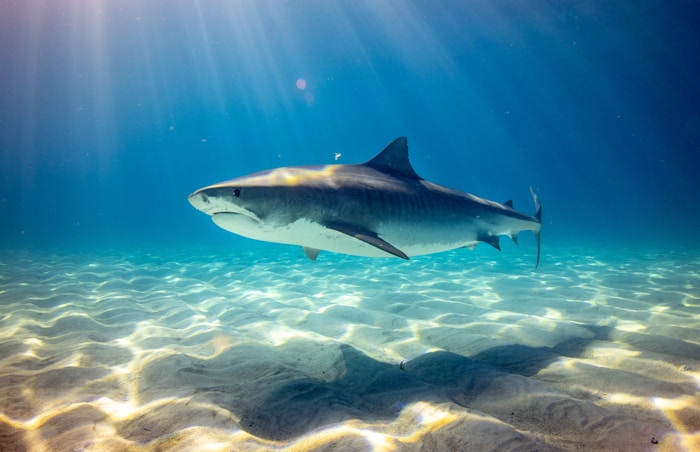
The unique spot pattern on a whale shark's skin acts like a fingerprint - no two individuals have identical markings.
Unique Patterns
Every single whale shark has a unique spot pattern, much like human fingerprints. No two individuals are identical. This has allowed researchers to:
- Track individual sharks across decades using photo identification
- Estimate population sizes without invasive tagging
- Map migration routes by matching photos from different locations
The Technology Behind It
Organizations like the Marine Megafauna Foundation and Wildbook for Whale Sharks use AI-powered photo matching to identify individual sharks from tourist photos. Your vacation snapshot could contribute to real science!
Did You Know? According to Wildbook for Whale Sharks, researchers have identified over 8,000 individual whale sharks worldwide using their unique spot patterns - and the database is growing every day thanks to citizen scientists!
Whale Shark vs Great White Shark
People often confuse these two because of the word "shark," but they could not be more different. This comparison helps explain why the whale shark is called a gentle giant while the great white commands respect as an apex predator.
| Feature | Whale Shark | Great White Shark |
|---|---|---|
| Type | Filter feeder | Apex predator |
| Diet | Plankton, tiny organisms | Seals, fish, dolphins |
| Teeth | 3,000+ tiny, useless | 300 large, serrated |
| Behavior | Docile, slow | Aggressive hunter |
| Danger to Humans | Virtually none | Rare but possible |
| Size | Up to 61 ft | Up to 20 ft |
| Speed | 3 mph | 25 mph (bursts) |
| Lifespan | 70-130 years | 30-70 years |
| Conservation Status | Endangered | Vulnerable |
Key Takeaway: If you see a whale shark in the water, grab your snorkel. If you see a great white, calmly head back to shore. Both are magnificent, but only one wants to be your swimming buddy.
How Scientists Study Whale Sharks
Studying the largest fish in the ocean is not easy. Whale sharks spend most of their time in remote tropical waters, and their deep-diving behavior makes them difficult to track. Yet scientists have developed remarkable techniques to learn about these gentle giants.
Photo Identification
The most common method is also the simplest: photography. By capturing images of a whale shark's unique spot pattern, researchers can identify individual animals and track their movements over time. This non-invasive technique has revolutionized whale shark research.
Satellite Tagging
Scientists attach small satellite tags to whale sharks that record:
- Location (GPS coordinates)
- Depth (how deep they dive)
- Water temperature
- Time spent at surface
These tags eventually fall off and transmit data, revealing migration routes that span thousands of miles.
Genetic Studies
By collecting small tissue samples (usually from sharks that swim near boats), researchers analyze DNA to understand:
- Population structure
- Genetic diversity
- Relatedness between individuals
- Evolutionary history
Latest Research (2025-2026)
Recent studies have revealed fascinating new insights:
- Longevity breakthrough: According to a 2025 study published in marine biology journals, new aging techniques suggest whale sharks may live over 130 years, making them one of the longest-lived fish species
- Deep diving secrets: Tagged sharks in the Maldives were recorded diving to 6,000+ feet, far deeper than previously thought
- Social behavior: Evidence suggests whale sharks may form loose social bonds, gathering in the same locations year after year
- Climate impact: Researchers documented shifting migration patterns linked to warming ocean temperatures
Conservation: Why Are They Endangered?
Despite their massive size, whale sharks face serious threats - mostly from us.
Major Threats
| Threat | Impact | Severity |
|---|---|---|
| Ship strikes | Collisions with boats cause injuries/death | High |
| Bycatch | Caught in fishing nets unintentionally | High |
| Plastic pollution | Ingest microplastics with plankton | Medium-High |
| Climate change | Altering plankton distribution | Medium |
| Illegal fishing | Fins and meat sold in some markets | Medium |
| Unregulated tourism | Boats harassing sharks, interrupting feeding | Medium |
These threats add up quickly. According to the IUCN Red List, whale sharks are classified as Endangered, meaning they face a very high risk of extinction in the wild.
Population Estimate
According to the latest research from the Marine Megafauna Foundation, scientists estimate there are fewer than 10,000 mature whale sharks left in the wild. That may sound like a lot, but spread across the entire world's oceans, it means some areas may have only a few hundred individuals.
What is Being Done
- CITES Appendix II: International trade of whale shark parts is regulated
- Marine Protected Areas: Key habitats like Ningaloo Reef are protected
- Eco-certification: Programs like "Whale Shark Friendly" promote responsible tourism
- Citizen Science: Tourists contribute photos to population databases
Swimming with Whale Sharks: A Responsible Guide
If swimming with a whale shark is on your bucket list, here is how to do it ethically.
Do's
- Maintain distance: Stay at least 10 feet (3 meters) away
- No touching: Their skin is sensitive; touching can remove protective mucus
- No flash photography: It can startle them
- Follow guide instructions: Local rules vary by location
- Use reef-safe sunscreen: Regular sunscreen harms plankton - their food
Don'ts
- Don't chase or block their path: Let them swim freely
- Don't use drones without permits: Many locations restrict aerial photography
- Don't support feeding operations: Artificial feeding changes natural behavior (looking at you, Oslob)
- Don't wear bright colors: Some studies suggest they may react to high-contrast colors
Best Places for Responsible Encounters
- Ningaloo Reef, Australia - Strictly regulated, limited daily permits
- Donsol Bay, Philippines - Community-based, no feeding
- Isla Holbox, Mexico - Seasonal but incredible aggregations
Fun Facts About Whale Sharks
Did You Know? Every whale shark has a unique spot pattern - just like a human fingerprint!
Here are more mind-blowing facts about the largest fish in the world:
| Record | Detail |
|---|---|
| Oldest recorded | Estimated 130+ years (new aging techniques) |
| Biggest recorded | 61.7 feet (18.8 m) - caught in 1949 near Pakistan |
| Heaviest recorded | 42,000 pounds (21 tons) |
| Deepest dive | 6,000+ feet (1,828 m) - Maldives, 2025 |
| Longest migration | 8,000 miles (13,000 km) - Panama to Philippines |
| Longest pregnancy | Unknown, but estimated 12-16 months |
| Smallest newborn | 21 inches (55 cm) - about the size of a house cat |
| Fastest growth | Up to 12 inches per year in juveniles |
| Most teeth | 3,000+ arranged in 300+ rows |
| Biggest mouth | 5 feet (1.5 m) wide - can fit a person standing up! |
These records make the whale shark one of the most extraordinary animals on Earth. From its tiny beginnings as a 21-inch baby to its potential 130-year lifespan, every stage of this animal's life is remarkable.
Whale Shark Timeline
| Year | Milestone |
|---|---|
| 1828 | First described by Scottish scientist Andrew Smith |
| 1867 | Scientific name Rhincodon typus officially recognized |
| 1980s | First eco-tourism operations begin in the Philippines |
| 1995 | First successful satellite tagging |
| 2005 | Wildbook for Whale Sharks database launched |
| 2016 | Listed as Endangered on IUCN Red List |
| 2020 | COVID-19 causes temporary decline in eco-tourism |
| 2023 | AI photo matching reaches 90% accuracy |
| 2025 | New study suggests lifespan exceeds 130 years |
| 2026 | Global population estimated at fewer than 10,000 mature individuals |
Interesting Numbers
Sometimes, numbers tell the story better than words:
| Number | What It Means |
|---|---|
| 300 | Rows of tiny teeth in their mouths |
| 3,000+ | Total teeth - none used for biting |
| 6,000 | Liters of water filtered per hour |
| 130 | Estimated maximum lifespan in years |
| 20 | Maximum weight in metric tons |
| 61.7 | Longest recorded individual in feet |
| 8,000 | Longest recorded migration in miles |
| 10,000 | Estimated mature population worldwide |
| 5 | Feet wide - their massive mouth |
| 21 | Inches - length of a newborn whale shark |
These numbers put into perspective just how extraordinary the whale shark is. From 21 inches at birth to potentially 61 feet at full size, the growth journey of this filter-feeding shark is unmatched in the animal kingdom.
Myths vs Facts
| Myth | Fact |
|---|---|
| "Whale sharks are whales" | Wrong! They are fish - the largest species of shark |
| "They can swallow humans" | Wrong! Their throat is only the size of an apple |
| "They are dangerous to swimmers" | Wrong! No unprovoked attacks ever recorded |
| "They have no teeth" | Wrong! They have 3,000+ - just do not use them |
| "They are slow and lazy" | Wrong! They migrate thousands of miles and dive deep |
| "Their spots are just decoration" | Wrong! Each pattern is unique, like a fingerprint |
| "They are the largest animal in the ocean" | Wrong! Blue whales are larger, but they are mammals |
| "They only eat plankton" | Wrong! Occasionally eat small fish and squid too |
Frequently Asked Questions
Are whale sharks dangerous to humans?
No. Whale sharks are filter feeders with no interest in large prey. According to marine safety records, thousands of people swim with them annually without incident.
How big is a whale shark compared to a blue whale?
Blue whales are larger (up to 100 feet), but they are mammals, not fish. Whale sharks are the largest fish - a different category entirely.
Can whale sharks live in aquariums?
Only a few aquariums worldwide have successfully kept whale sharks, and even then, they require enormous tanks. Most are released back into the wild.
Why do whale sharks have spots?
The exact purpose is still being studied, but theories include camouflage (countershading), species recognition, and protection against UV radiation.
How can I help whale shark conservation?
Choose responsible eco-tourism operators, reduce plastic use, support organizations like the Marine Megafauna Foundation, and report sightings to citizen science databases.
What is the difference between a whale shark and a basking shark?
Both are filter-feeding sharks, but basking sharks are smaller (up to 40 feet), have a more pointed snout, and are found in cooler waters.
Conclusion: Why the Gentle Giant Matters
The whale shark is more than just a record-holder for size. It is a reminder that the ocean's most impressive creatures do not have to be fearsome to be fascinating.
In a world where we often celebrate predators for their power, the whale shark stands out for its gentleness. It swims through the ocean not as a hunter, but as a peaceful giant, filtering the water and keeping marine ecosystems balanced.
Every time a tourist shares a photo of a whale shark encounter, every time a researcher matches a spot pattern, and every time a community chooses sustainable tourism over exploitation, this gentle giant gets a little safer.
The next time someone asks you about the most amazing animal in the ocean, you might just find yourself talking about a 40-foot fish that eats plankton, has 3,000 useless teeth, and would not hurt a soul.
Related Reading
If you are interested in marine life, explore our complete shark guides to learn how whale sharks, great whites, and basking sharks differ:
About the Author
Vinit Rangra is an animal blogger and marine life enthusiast who runs Vinimal, a blog dedicated to sharing well-researched wildlife guides. Through years of reading scientific papers, following marine research, and engaging with conservation communities, he aims to make complex animal science accessible to everyone. When not writing, you will find him exploring nature documentaries and planning his next wildlife adventure.
References & External Sources
- IUCN Red List - Whale Shark (Rhincodon typus)
- National Geographic - Whale Shark Facts
- WWF - Whale Shark Overview
- Marine Megafauna Foundation - Whale Shark Research
- Wildbook for Whale Sharks - Photo Identification Database
- Natural History Museum, London - Whale Shark Size Guide
- Australian Institute of Marine Science (AIMS) - Ningaloo Reef Whale Shark Research
- Smithsonian Ocean Portal - Whale Shark Profile
- NOAA Fisheries - Whale Shark Conservation
- CITES - Appendix II Listing
2026 Whale Shark Facts: Size, Diet, Habitat & Why It's Called the Gentle Giant - All Rights Reserved


